
Art and Media in Times of Crisis
August 26, 2026
Written by Anna Koski-Harja, YCW Curatorial and Public Engagement Assistant, 2026
“The next time the government faces a choice between civil liberties and national security. How can we ensure a just balance?”1
That is the question that Lost Liberties – The War Measures Act leaves visitors with. This travelling exhibition curated by the Canadian Museum of History is currently on view at the Peterborough Museum & Archives until September 13, 2026. This summer my role as Curatorial and Public Engagement Assistant (part of the Young Canada Works Program) took me on a field trip to the Peterborough Museum & Archives (PMA). What started as research on Dennis Tourbin, an artist in the AGP Permanent Collection, became an expanded look at his works on the October Crisis and the invocation of the War Measures Act. I was lucky enough to get to explore the PMA’s permanent exhibit on the history of Peterborough and get a behind-the-scenes tour of their archive, seeing both two-dimensional and three-dimensional artifacts.
After seeing the Lost Liberties exhibit, I kept returning to ideas of media, its influence over time, and how art is so deeply intertwined and informed by times of crisis.
A Sneak Peek into Lost Liberties
The Lost Liberties exhibit not only teaches the history of the War Measures Act but emphasizes the personal impact that it had on Canadians. The exhibit is split up into three major sections covering each time the act was invoked. It was passed in 1914 during the First World War; it was invoked again in the Second World War and controversially invoked during peacetime in October 1970 due to the Front de liberation du Québec’s (FLQ) kidnapping of two government officials. For me, the most striking part of the exhibit were the maps that marked various internment camps across the country. It was interesting to see where certain provinces had higher concentrations of camps, like in British Columbia during WWII when Japanese Canadians were persecuted and prohibited from entering parts of the province.
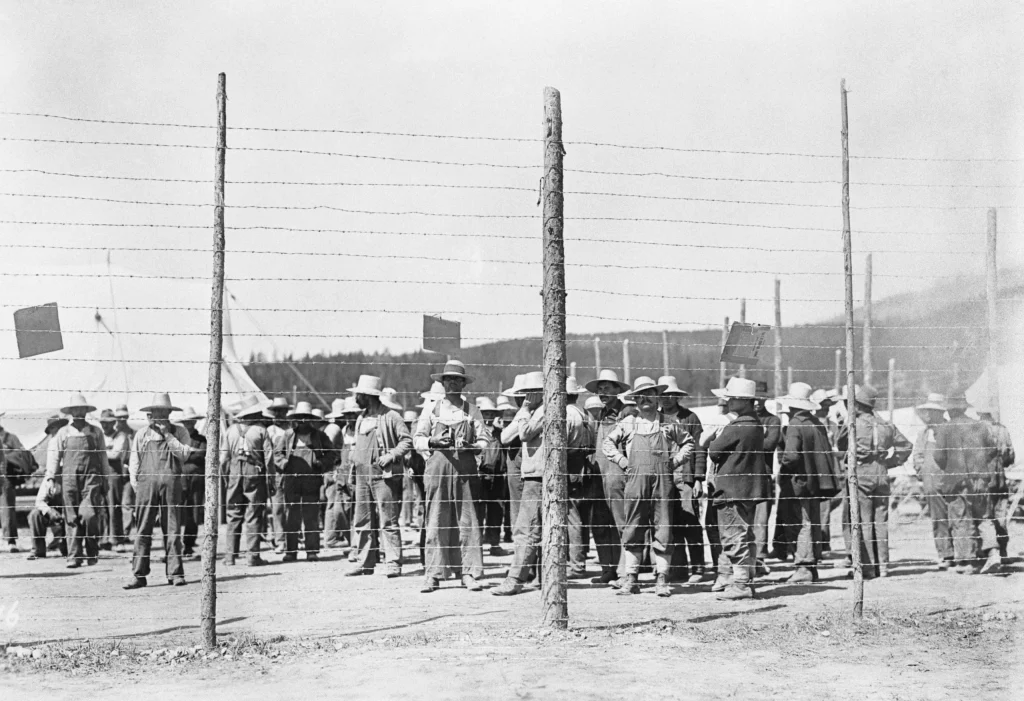
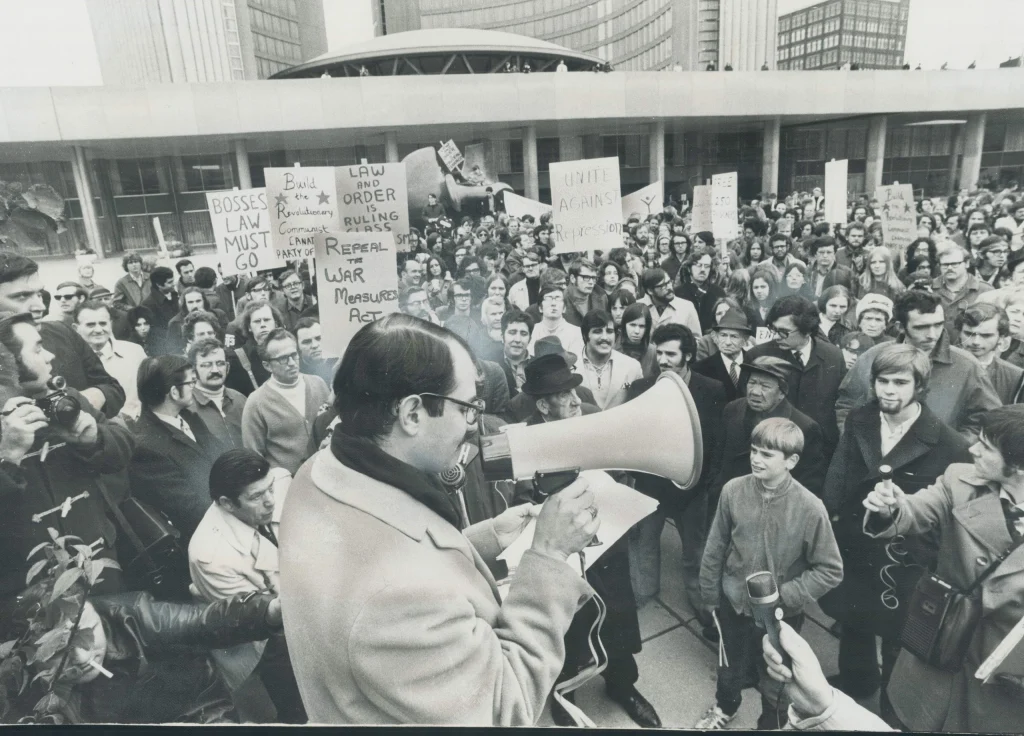
An important part of this exhibit is the documented experiences of those affected and the reactions about forced censorship, legal discrimination, and imprisonments. There was a lot of dissent in 1970 when hundreds were arrested with suspected associations to the FLQ, many of them artists or activists. Lost Liberties has made clear for me that artists have always played an important role in times of crisis. Whether it is making politically charged art or reflecting on the impacts later, it is a pattern seen time and time again in response to moments of conflict. The exhibit also reminded me how these discussions remain relevant today. A recent example is when the Emergencies Act that replaced the War Measures Act in 1988 was invoked in reaction to the COVID protocol protests centered in Ottawa in 2022.
Memories of the October Crisis
When learning about history I always appreciate the perspectives of the people who have lived through it, even if they think their experience is ordinary. The October Crisis occurred in 1970 and there are many living people who recall this tumultuous period. As part of my visit to the Peterborough Museum and Archives, I had the opportunity to chat with Susan Neale, PMA Museum Director. She shared with me that she was in elementary school and living in Quebec during the 1970s. She has memories of sitting in the school yard on multiple occasions as the building was searched due to bomb threats. She also shared that her friend’s neighbour was arrested as part of the mass arrests following the invocation of the War Measures Act. As a young child at the time, she recalls being most concerned about the tight restrictions on Halloween.
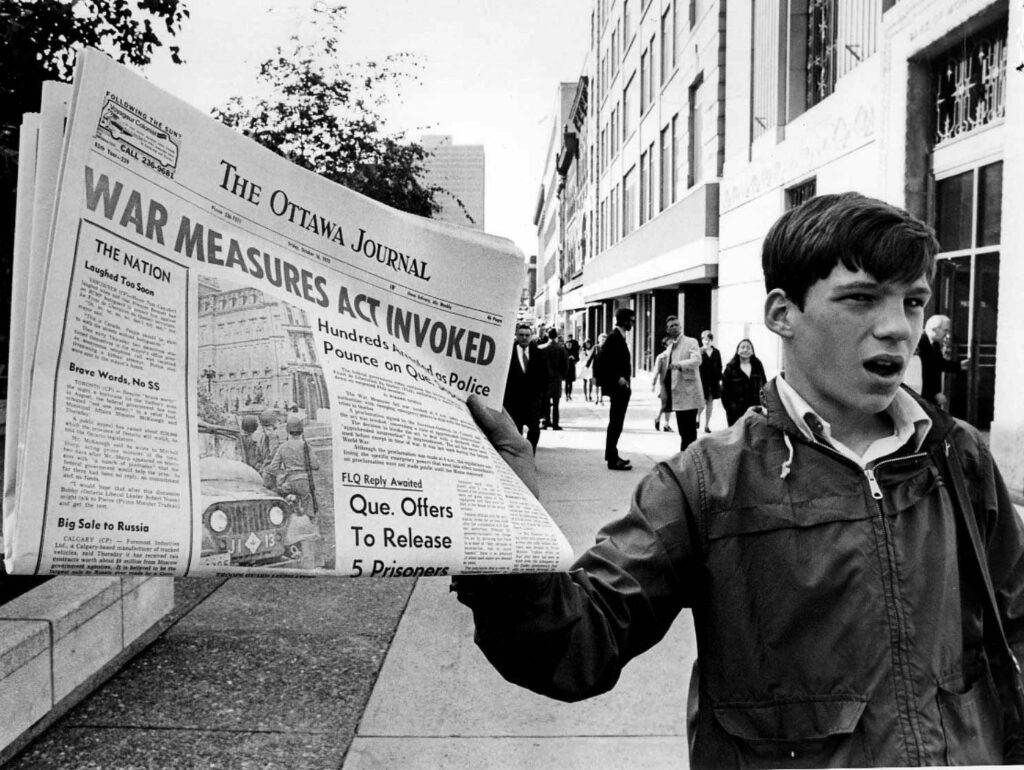
For most, especially those living outside of Quebec, they experienced the events of the October Crisis through the media. For example, Ontario-based artist Dennis Tourbin was out on a fishing trip when he heard about it through the radio. It was spread across newspapers and broadcasted heavily over the radio.
I reflected on that fact and how my family’s experience living in Ontario was very similar. I remembered however that my great-aunt, Pirkko Menard, was living in downtown Montreal in 1970 with her husband. I phoned her to discuss what she remembers about that time, and she recalled her daily life proceeding as normal. Like many, she could not escape hearing about it all over the news. For her, what changed was the amount of police officers and soldiers all over the place. Always with a sense of humour, she as a twenty-five-year-old was not impressed with all of it. She felt that it was just politics and they would figure it out. However, she did mention that once Pierre Laporte was found dead, there was increased insecurity, worry about further escalation, and what would happen next.
Art and Media in Times of Crisis
It is widely agreed that we live in the most media saturated time to date, where news is spread virally through social media long before it appears as a printed headline. The Lost Liberties exhibit revealed to me that the media has played a role in how events are perceived even since the beginning of the War Measures Act. In examining its impacts, the exhibition displayed examples of propagandistic cartoons and advertisements that were used to sway the public’s actions and opinions during both the First and Second World War.
In talking with people who experienced the October Crisis, I discovered that the media, particularly newspapers, played a direct role in their perceptions and opinions, and for many it was how they experienced the events themselves. I was also surprised to learn that the FLQ manifesto was broadcast on live radio, especially understanding the impact and reach of radio in a time before the internet. I have seen in our current day, countless groups co-opt social media for their own goals, and it is fascinating to see that although the types of media have changed, it has consistently remained a powerful tool in shaping a public perception.
Alongside media, art has also played a strong role in times of crisis. Many artistic movements of the twentieth century were in reaction to global events and conflict. Dennis Tourbin is a perfect example of this. His art is not only a reaction to a crisis, but a reflection of the way that language and media influence our every day lives.
An Artistic Reaction
Before going to the exhibition at the PMA, I was made aware that the artist Dennis Tourbin gained popularity for his works examining the events of the October Crisis. For Tourbin, it became an artistic obsession, driving his work and what ultimately made a name for himself.
Dennis Tourbin was born in 1946 in St. Catharines, Ontario. His practice spanned multiple mediums including, painting, poetry, and performance. His work is reminiscent of pop art traditions but with a clear focus on personal or Canadian subject matter. Throughout Tourbin’s life he was very influenced by Canadian philosopher, Marshall McLuhan, and his now famous phrase, “the medium is the message.” Tourbin had a fascination with text, language, media, and television. These subjects and their juxtapositions were the focus of many of his paintings. Tourbin’s art sought to capture the media of a specific moment and place it in conversation with other media to understand its context.
It wasn’t until two decades after the October Crisis that Tourbin started to grapple with the events of 1970 in his art. Tourbin’s works replicate newspaper clippings in paint on large canvases. He combined these fragments and highlighted how multiple events were being reported on at the same time. His work focused on reflecting the collective memory of events back to viewers. Working in both colour and black and white, these pieces create heavy contrasts that replicate the competing headlines of the media. His works were controversial for their display of traumatic events that were still fresh in the country’s collective memory. They put a mirror up to the actions of not only the government but the way the media reported or sensationalized the events.
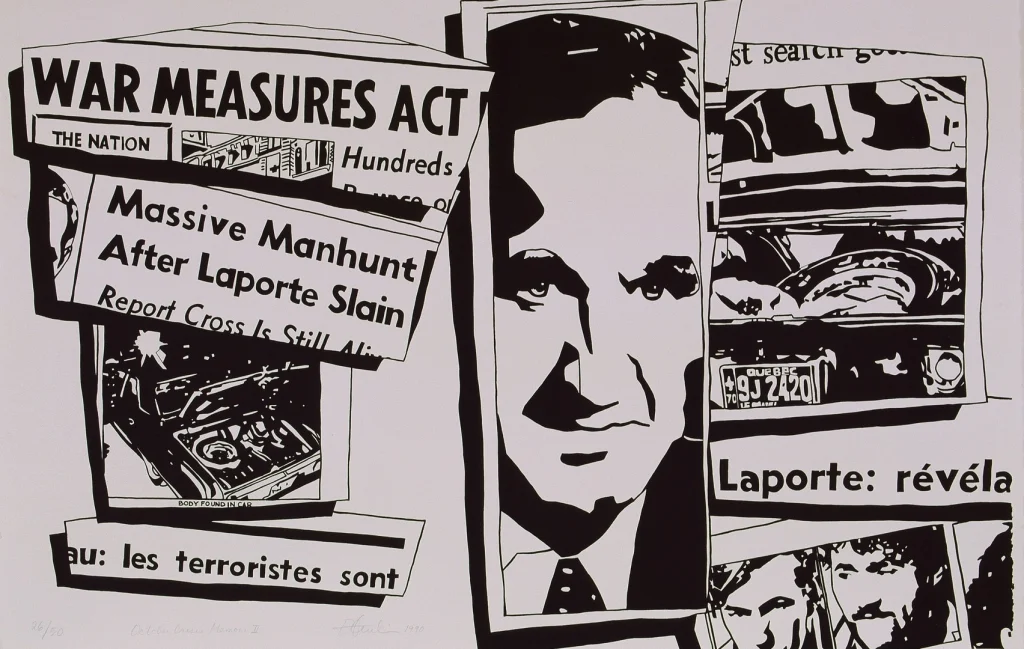
His works on the October Crisis put Dennis Tourbin in the spotlight when the National Gallery of Canada cancelled their exhibition of his work. In 1995 Tourbin had a planned solo show at the Ottawa Art Gallery (OAG) so he reached out to the National Gallery of Canada to see if they wanted to display his larger works. They agreed, however during the planning period the media caught wind of the exhibition. As it was the twenty-fifth anniversary of the events of October 1970 and the second referendum on whether Quebec would separate from the rest of Canda, there was an explosive backlash against the show and Tourbin’s work. People saw his art as dangerous for its possibility to sway votes and as insensitive reminders to the families of those effected by the October Crisis. The Ottawa Art Gallery went ahead and presented the work gaining Tourbin national attention and acclaim while the National Gallery of Canada cancelled their exhibition of Tourbin’s work, informing the artist over voicemail. This damaged the reputation of the gallery and its relationship with artists, but due to the media attention resulted in boosting Tourbin’s fame.
What I have learned from this exhibit and my research is that there is more to history than what you see reported in the news. There are stories that don’t get reported or are purposely obscured. There are the everyday experiences that might seem unremarkable but are an integral part of the history. Sometimes the true impact of a crisis is not fully understood till you hear about the individuals who were affected and their personal stories. Art can be a way to reflect on not only your own experiences but those of others. Dennis Tourbin understood that, and now I do too.
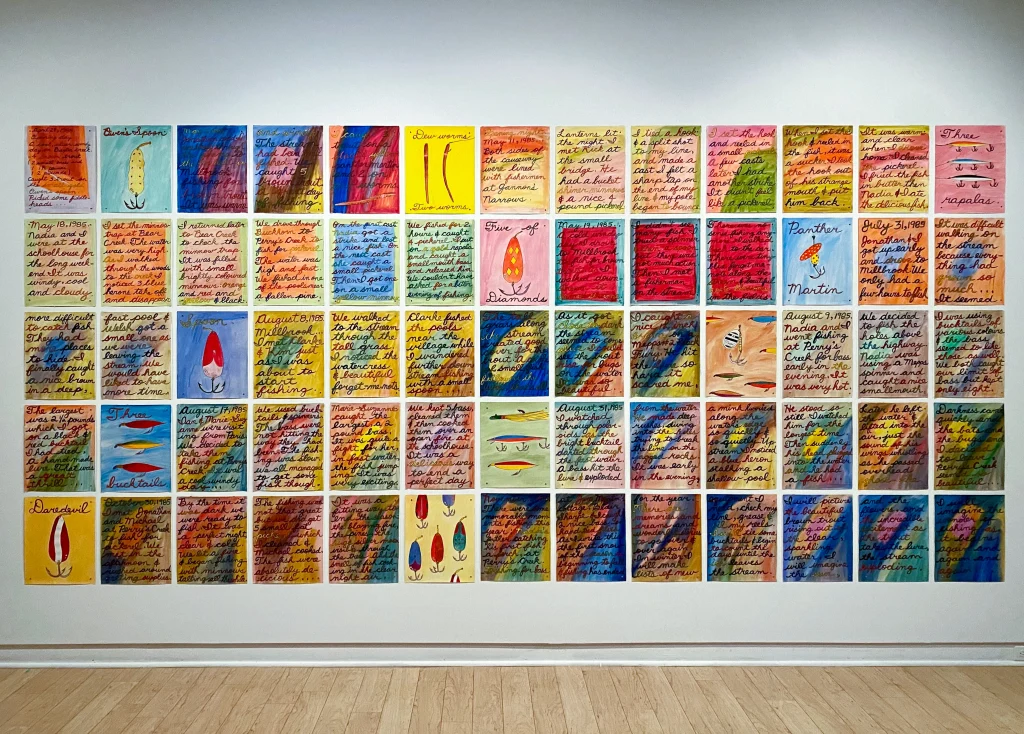
Dennis Tourbin was an influential arts activist and was a large contributor to the growth of the contemporary art practices in southern Ontario. Tourbin was a founding member of Niagara Artist’s Co-op (now known as Niagara Arts Centre) in St. Catharines. He is also deeply connected to Peterborough and is one of the founders of Peterborough Artists Inc. (now known as Artspace) in 1974. He moved to Peterborough in 1969 and lived here until his artist-in-residence in Paris, France in 1982. Once he returned to Canada, he moved to Ottawa in 1983. Here, he left an incredible legacy, working with many local artists, creating art across several disciplines, and contributing to the growing arts scene in Peterborough with impacts that reverberate through the community to this day. As a key figure in the history of the art scene in Peterborough, the Art Gallery of Peterborough holds two of his works in their Permanent Collection: Fishing Post Modern (for Dave Gordon) from 1985 and The TV is a Poem from 1974.2 His work has been shown through the AGP’s history with solo shows in 1981, 1997, and 2014, and group exhibitions in 1980, 2004, 2015/2016, 2017, and 2020.
Anna Koski-Harja is the 2026 Young Canada Works Curatorial and Public Engagement Assistant for the Art Gallery of Peterborough. She holds a BA in Architectural Studies from the University of Toronto and is pursuing a Masters in Art and Architectural History at Carleton University. An emerging art and architectural historian, she hopes to work in the field of heritage. She wants to learn and teach others about Canada’s rich artistic history.
- Quote from didactic of Lost Liberties – The War Measures Act at the Peterborough Museum and Archives, a travelling exhibition developed by the Canadian Museum of History and generously supported by a grant from the Endowment Council of the Canadian First World War Internment Recognition Fund. ↩︎
- Dennis Tourbin, “The TV is a Poem,” acrylic on canvas over plywood, 1974. Collection of the Art Gallery of Peterborough. Purchased with the assistance of the Ministry of Citizenship and Culture through a Wintario Grant, 1981. ↩︎
Posted in In the Community, Permanent Collection